USAAF
B-17G FLYING FORTRESS PILOT
91st BOMBARDMENT GROUP, 401st BOMBARDMENT SQUADRON
A Greek American boy from Wisconsin to the deadly skies of the Western Europe
Peter Archie Pastras was born on 4 May 1922 in the City of Oconto, Oconto County, Wisconsin, the son of Harry Pastras, a candy maker born in Kokari village in Samos island in Greece, and Anna (née Biron) Pastras, a native of Wisconsin. His birth was officially recorded by the Wisconsin Department of Health, Bureau of Vital Statistics, under Certificate No. 311492.¹ During the late 1920s the family relocated to Lansing, Michigan, where Pastras was raised and educated. Contemporary local records consistently identify him as a Lansing resident. He completed four years of high school prior to entering military service.² On 9 November 1942, Pastras enlisted in the United States Army Air Corps at Lansing, Michigan, and was assigned Army Serial Number 16119867.³ He subsequently entered the Army Air Forces pilot training pipeline. His Individual Flight Record documents a steady progression through primary, basic, and advanced phases, including night flying, formation work, and instrument instruction. Early entries record time in single-engine trainers before transition to more demanding aircraft.⁴ By late 1943 Pastras had advanced into twin-engine training, accumulating longer sorties and demonstrating proficiency sufficient for continuation toward heavy bomber qualification. On 15 April 1944, he was formally rated as a pilot. By that date his cumulative flight time totaled approximately 267 hours, including substantial first-pilot time and initial transition hours in B-17 Flying Fortress aircraft.⁵ Following commissioning as a Second Lieutenant in April 1944, he underwent additional crew assembly and heavy bomber preparation at Drew Field, Florida, and associated replacement training units under III Bomber Command.⁶ In mid-1944 Pastras was deployed overseas to the European Theater of Operations. By late 1944 he was assigned to RAF Bassingbourn (Station 121) in Cambridgeshire, England, as a pilot with the 401st Bomb Squadron, 91st Bomb Group (Heavy), one of the Eighth Air Force’s most experienced heavy bomber units.⁷ From December 1944 onward, Pastras flew sustained combat operations as a B-17G aircraft commander. Although he is most closely associated with B-17G Times A-Wastin’ (AAF serial 42-102504, squadron code LL-D), squadron records and flight documentation show that he flew a succession of different airframes as operational requirements dictated, reflecting the realities of late-war bomber operations marked by mechanical attrition, battle damage, and rapid crew rotation. His recorded aircraft included B-17G serials 43-38035 (LL-P), 43-38036 (LL-H), 43-39014 (LL-C), 43-39217 (LL-O), 42-97061 (LL-B), 43-38843 (LL-S), and other temporarily assigned aircraft, prior to his final association with Times A-Wastin’.⁸ Actually he flew most of his missions with 43-38036 (LL-H) "Hey Daddy". During the opening months of 1945, Pastras flew a demanding series of long-range missions during the most intense phase of the Eighth Air Force’s strategic bombing campaign. Flying repeatedly with a core crew that often included 2nd Lt. George Louis Latches as navigator, his missions ranged across western, central, and eastern Germany. Targets included railway marshalling yards and locomotive repair facilities at Cologne, Kassel, Halle, Aschersleben, Rheine, Salzbergen, and Stendal; industrial and armament centers at Dortmund, Gotha, Chemnitz, and Plauen; oil-related and fuel-dependent industrial targets in Hamburg and the Ruhr region; and airfields and military installations at Paderborn, Ingolstadt, Aschaffenburg, and Fassberg, with several sorties penetrating the heavily defended Berlin zone or its approaches.⁹ Operations were conducted under widely varying conditions—some missions bombed visually through breaks in cloud, others entirely by instruments when overcast obscured primary objectives—requiring disciplined formation flying and precise execution of radar-controlled bomb runs. Pastras flew in varying formation roles, including high and low squadron positions and, on occasion, elements of lead formations. He repeatedly encountered moderate to accurate anti-aircraft fire, particularly over rail and industrial targets, while fighter opposition, though diminishing by early 1945, remained an operational factor.¹⁰ Several sorties were flown in support of electronic countermeasures operations, with Pastras’s aircraft carrying Carpet Jammer equipment designed to disrupt German radar-directed flak and fighter-control systems. On these missions his aircraft functioned not only as a bombing platform but as an airborne component of the Eighth Air Force’s electronic warfare effort, contributing directly to the protection of the wider formation during penetration and withdrawal from heavily defended airspace.¹¹ The cumulative strain of repeated long-range sorties is evident in the rapid operational tempo, frequent aircraft substitutions, and constant exposure to dense flak belts surrounding major objectives. Throughout this period, Pastras demonstrated the steadiness and technical competence expected of an aircraft commander, responsible for flying a fully loaded B-17 for hours at altitude, coordinating closely with his navigator and crew, maintaining formation integrity under fire, and returning his aircraft whenever circumstances allowed. His combat record was defined by consistency, professionalism, and duty carried out during the final drive toward victory in Europe.¹²
A candid wartime photograph showing the officer of the B-17G Time’s A-Wastin’, with an unidentified crewman at far left, followed by Robert Franklin Morris serving as co-pilot, George L. Latches as navigator, and Peter A. Pastras as pilot. Latches and Pastras shared a common Greek-American heritage, and all four men are seen wearing their issued pistols, a detail that reflects their operational status and the everyday realities of life on an active Eighth Air Force bomber base. (Pastras Family)
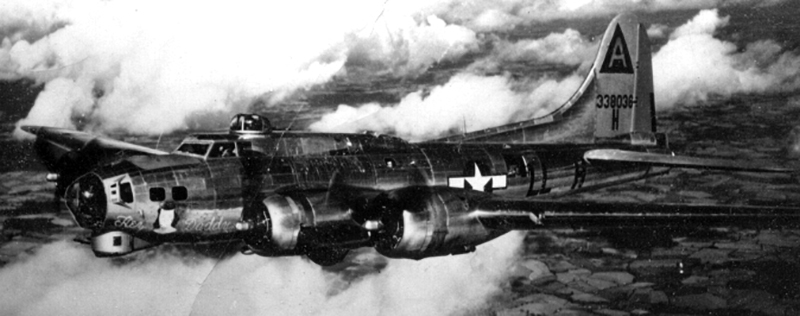
B-17G 43-38036 “Hey Daddy” – Lt. Peter A. Pastras and his crew during a training mission in the United States prior to deployment to the European Theater of Operations. Lt. Pastras is seated in the pilot’s position, reflecting his role as aircraft commander, while T/Sgt. Robert A. Smith is visible in the radio operator’s window, underscoring the coordinated teamwork essential to heavy bomber operations. Aircraft 43-38036, nicknamed Hey Daddy, would later serve in combat with the 401st Bomb Squadron, 91st Bomb Group (H), Eighth Air Force, flying strategic bombing missions over occupied Europe and Germany. (American Air Museum UPL 18537, original in Pastras family)
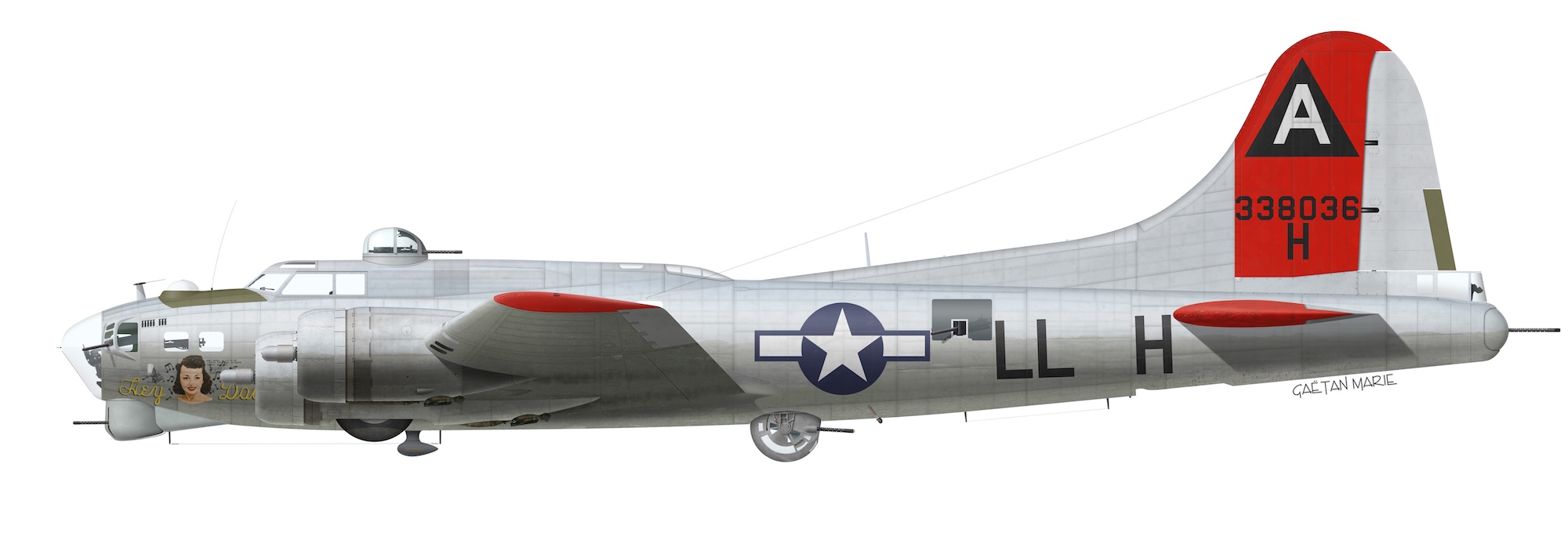
The B-17G-75-BO, serial number 43-38036, known by the squadron code LL-H and the nickname "Hey Daddy," was a Flying Fortress assigned to the 401st Bomb Squadron of the 91st Bomb Group (Heavy). Manufactured by Boeing (block 75-BO), it was delivered from the Cheyenne plant on 19 June 1944, transferred to Kearney on 28 June, and then to Dow Field, Maine, on 13 July. On 22 July 1944 it deployed overseas to RAF Bassingbourn (Station 121) in England. It was initially assigned to the 322nd Bomb Squadron with the code LG-D; shortly thereafter it was transferred to the 401st Bomb Squadron, receiving the identification code LL-H. The nose art "Hey Daddy" was painted by Corporal Anthony L. Starcer, the well-known artist of the 91st Bomb Group. The artwork was regarded as one of his most accomplished pieces and effectively became emblematic of the group. The aircraft served in a Pathfinder Force (PFF) lead role, guiding bomber formations by radar during July and August 1944. Its first PFF mission was to the heavily defended target at Merseburg on 29 July. For these lead missions, different crews flew the aircraft, and by November 1944 it was replaced in the PFF role by newer aircraft. In February 1945, "Hey Daddy" was temporarily withdrawn from front-line bombing operations and fitted with “Carpet Jammer” radio countermeasure equipment, designed to interfere with German radar-directed anti-aircraft defenses. During this period, it may have been loaned to other units, but in April it returned to regular combat service and was reassigned to the 322nd Bomb Squadron. By that time, it had completed at least eighteen combat missions. According to later accounts, the aircraft flew from Bassingbourn beginning in late July 1944 and survived the war, returning safely to the United States roughly one year later. Following the Allied victory in Europe, "Hey Daddy" departed for the United States on 11 June 1945, arriving at Bradley Field, Connecticut, and was assigned to the 4168th Base Unit at South Plains, Texas, on 14 June. In December 1945, it was turned over to the Reconstruction Finance Corporation at Kingman, Arizona, where it was ultimately scrapped. Although Peter A. Pastras was flying aboard Times A-Wastin’ when he was killed in action, operational records indicate that he flew numerous earlier missions in "Hey Daddy." The aircraft was one of the principal bombers of his squadron during the latter half of 1944 and the opening months of 1945, forming part of the operational backbone of the 401st Bomb Squadron during the climactic phase of the air war over Germany. (Copyright Bertrand Brown aka Gaetan Marie)
Passing to Eternity: Stendal, 8 April 1945
By early 1945 Pastras had been promoted to First Lieutenant. For sustained meritorious achievement in aerial operations over enemy territory he was awarded the Air Medal with five Oak Leaf Clusters. He was later awarded the Purple Heart posthumously.¹³ His letters vividly portray his daily life during his time in service.
March 6, 1945
"Dear Folks,
Well, I will write a several page letter and try to make up for the last few days that I haven’t written. You see Dom is here visiting me and before he got here, I was on the Continent for a day. Well now to start from scratch and tell you all about it on the last mission I was on we had an engine go out on us and we had to feather (?) it over enemy territory and come back on 3 engines. Well, we didn’t have enough gas to get back to England, so we landed in Belgium. I am sending Evelyn a couple of souvenirs from where we were, and I’ll enclose a handmade (I guess it is doily). It is handmade and one of the nicest ones I have. I’ll enclose it in this letter. Well we landed over there one afternoon at about 2:30 and the next day 6 P.M. we were here at our own field. And it was a good thing we were too as the next day Dom got here. He has been here 3 days. Gee it sure is good to see him. He is just about ready to go back to London now. He really looks good too. It just worked out good too and haven’t flown since he has been here, and the weather is nice so we have had a good time. He is about ready to leave now so I’ll finish this after I see him off at the station. Well Dom is probably in London now as his is going to spend a few days there and then he goes back to Paris. He is going to send me some souvenirs. Margaret probably will get a big kick out of the letter he wrote here especially the envelope. Dom looks just like the same old Dom, and it really was goo to see him. Well, it is late, so I’ll close for now. Please send a package.
Love to all
Pete"
Few days later he sent another letter
19 March 1945
"Dear Folks,
Just a note as it is 11:08 P.M. and I have to fly tomorrow. I and the crew are all well and we are happy too. We can begin to see our trip home and it is looking much better every day. Next month at this time I should be all finished here. I went to communion this morning. The chaplain here at the base is out every morning on the end of the runway to watch us take off on the mission each day we fly. He is really a swell guy always a cheerful word and smile. I haven’t had any mail lately, but I know it is on the way, so I don’t feel too bac about it. I’ll probably get about 15 or 20 letters in a bunch and have to answer them all in a bunch. Oh yes, I am a 1st Lt. now. I got the orders today they are effective from the 14th so I have been a 1st Lt. for 5 days. I knew it was coming soon but I didn’t know just when. I will write Jack tomorrow or the next day and tell him & Pam. Well, I got to hit the hay,
Love to all
Pete
P.S.
I have some stories to tell you when I see you.
SEND ME SOME COOKIES"
Regrettably, the satisfaction he experienced at the conclusion of his service was not to be realized, as he was shot down over Germany just a few days later. On 8 April 1945, Pastras led Times A-Wastin’ on a bombing mission against Reichsbahn locomotive repair and marshalling facilities at Stendal, Germany, part of 91st Bomb Group Mission No. 329. The crew of Times A-Wastin’ consisted of 1st Lt. Peter A. Pastras (pilot), 2nd Lt. Robert F. Morris (co-pilot), 2nd Lt. George L. Latches (navigator), T/Sgt. Lyle D. Jones (engineer/top turret gunner), T/Sgt. Robert A. Smith (radio operator), Sgt. Edgar L. Harrell (ball turret gunner), S/Sgt. George Wong (waist gunner), S/Sgt. Robert O. Smith (tail gunner), and S/Sgt. Donald H. Lemons (bombardier).¹⁴ Bombing was conducted through cloud using radar. Enemy fighter opposition was limited, but anti-aircraft defenses in the target area were intense.¹⁵ According to eyewitness statements compiled in Missing Air Crew Report (MACR) No. 14295, Pastras’s aircraft sustained direct flak hits over the target. Observers reported the No. 2 engine engulfed in flames, severe structural damage to the wing and fuselage, and loss of control shortly after bomb release. Witnesses described the aircraft pulling sharply upward, rolling onto a wingtip, and entering a steep, uncontrolled dive before disintegrating in mid-air. At least one parachute was observed, but the majority of the crew were unable to escape.¹⁶ As a result of the shootdown, seven members of the crew were killed in action. Two crewmen—T/Sgt. Lyle D. Jones and T/Sgt. Robert A. Smith—successfully bailed out, were captured by German forces, and survived the war as prisoners of war. Pastras and the remaining crew were initially listed as Missing in Action.¹⁷ Following Germany’s surrender, extensive recovery and identification operations were conducted by the American Graves Registration Service. Pastras’s remains were initially buried near Jarchau, Germany, and recorded as Unknown X-399. Subsequent forensic investigation—including dental chart comparison, correlation with MACR 14295, and crew association from aircraft 42-102504—led to formal identification. A Quartermaster General memorandum dated 23 November 1945 concluded that Unknown X-399 was 1st Lt. Peter A. Pastras, O-828502.¹⁸ A corrected Report of Burial, dated 3 November 1945, confirmed Pastras’s reinterment at the Netherlands American Cemetery, Margraten, Plot HH, Row 6, Grave 142. His Individual Deceased Personnel File (IDPF) preserves extensive correspondence documenting the prolonged efforts of his family to obtain definitive information regarding his fate and burial, including communications with the War Department, the Quartermaster General, and Senator Arthur H. Vandenberg.¹⁹ Final confirmation of permanent overseas burial was conveyed to the family in June 1949, following transfer of cemetery responsibility to the American Battle Monuments Commission.²⁰ 1st Lt. Peter Archie Pastras is commemorated at the Netherlands American Cemetery, Margraten, where his grave bears his name, rank, unit, and date of death. He was twenty-two years old at the time of his death a fate which shared along with his navigator and fellow Greek American Lt. George Louis Latches.
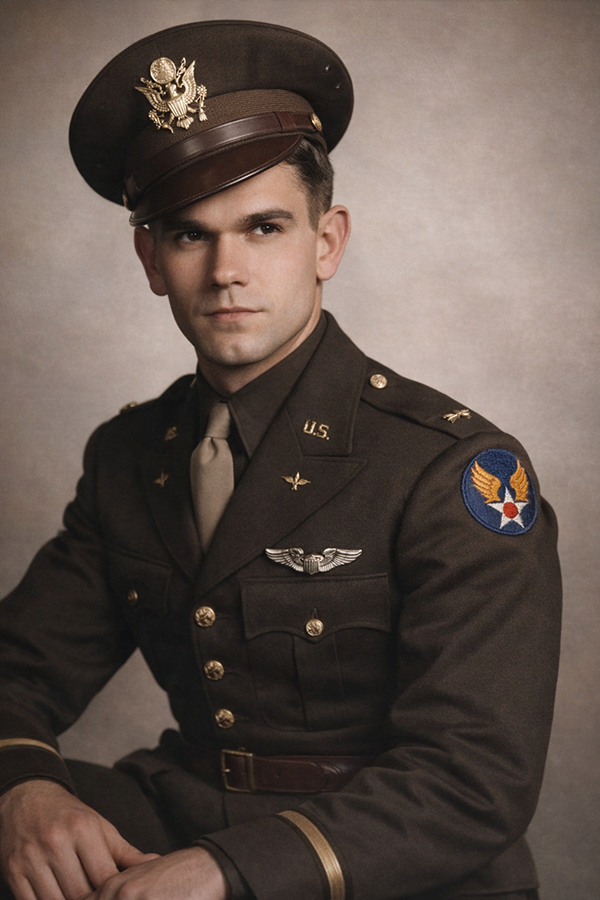
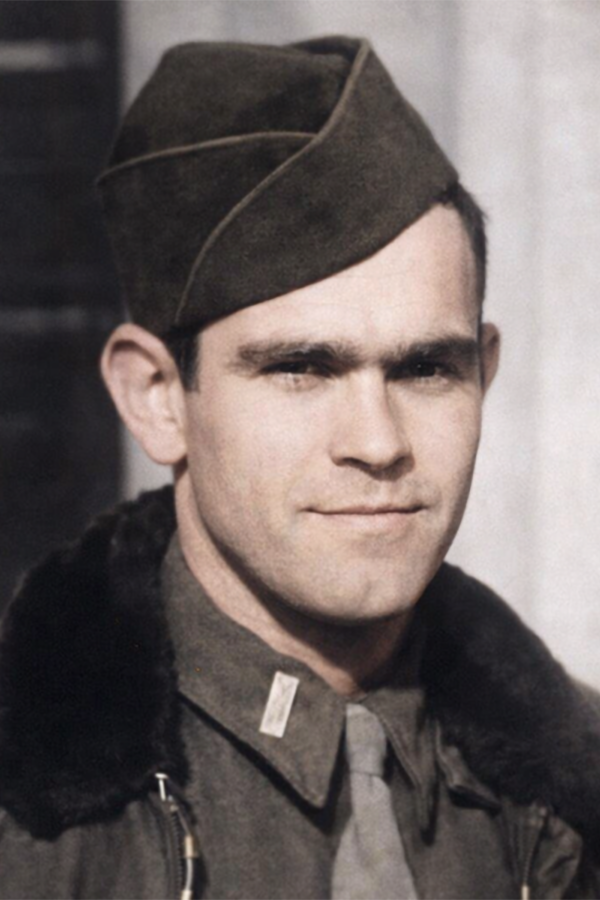
A formal wartime portrait of Peter A. Pastras, pilot of the B-17G Times A-Wastin’, showing him in U.S. Army Air Forces officer’s service dress with pilot wings, probably taken in England. (Pastras Family)
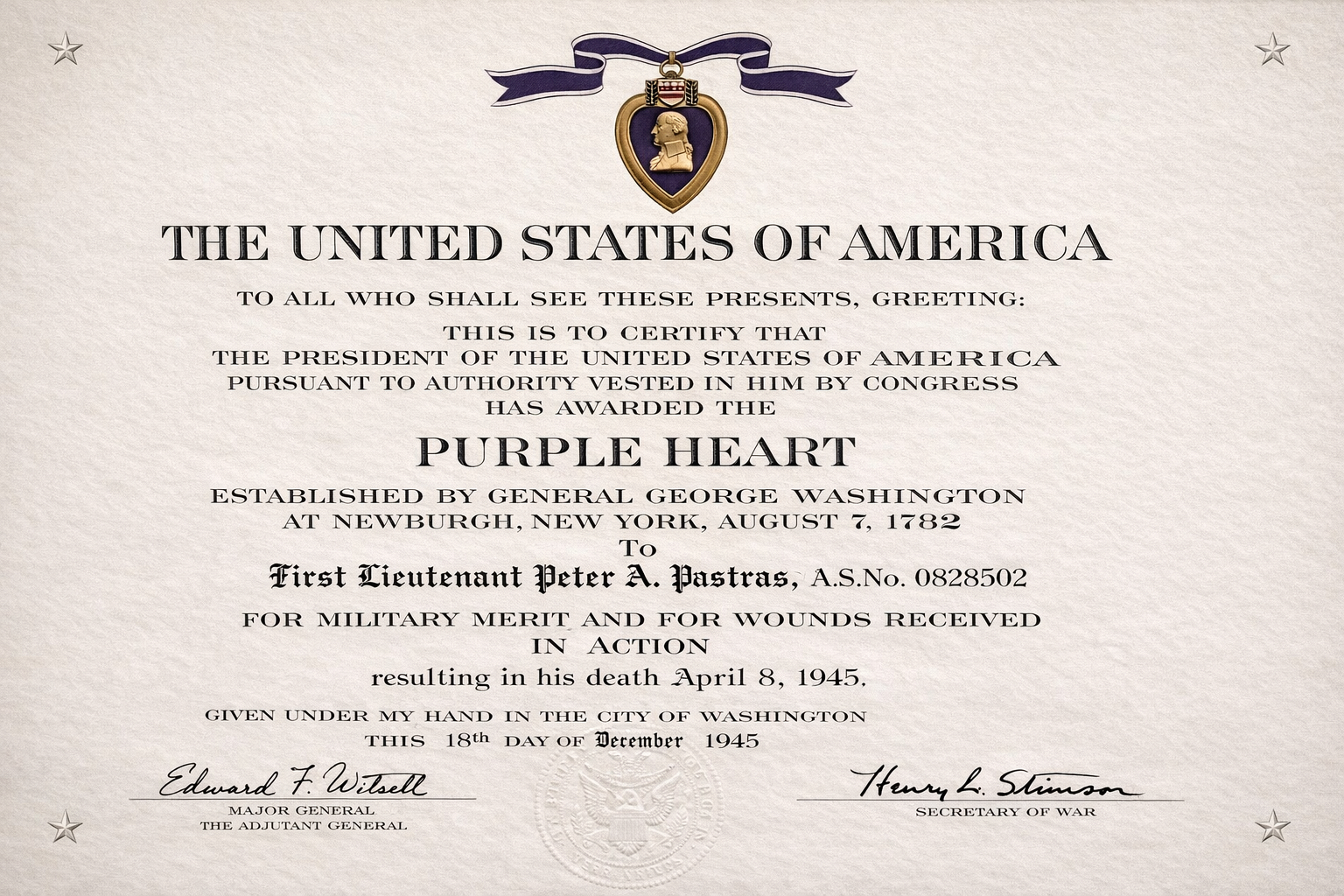
Purple Heart award replicate from original own by the family. (Pastras Family)
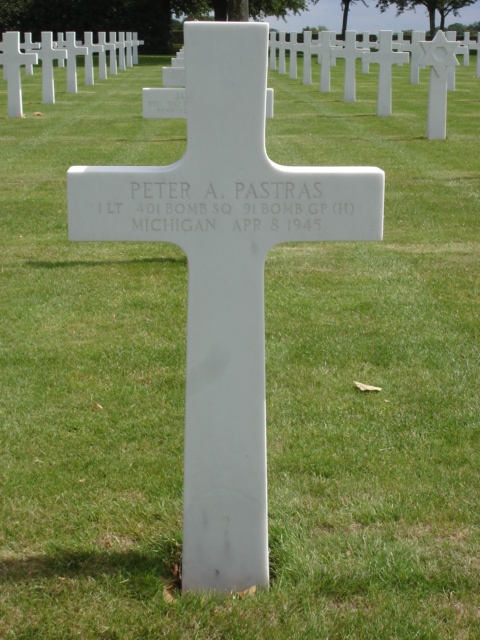
Pastras final resting place is at the Netherlands American Cemetery, in Margraten, Eijsden-Margraten Municipality, Plot M, Row 10, Grave 9. In Margraten rests more than 8,000 American servicemen who gave their lives in the liberation of Europe during the Second World War. A sacred field of white crosses and Stars of David, standing in solemn testimony to sacrifice and remembrance. (https://www.findagrave.com/via user named "Fred")
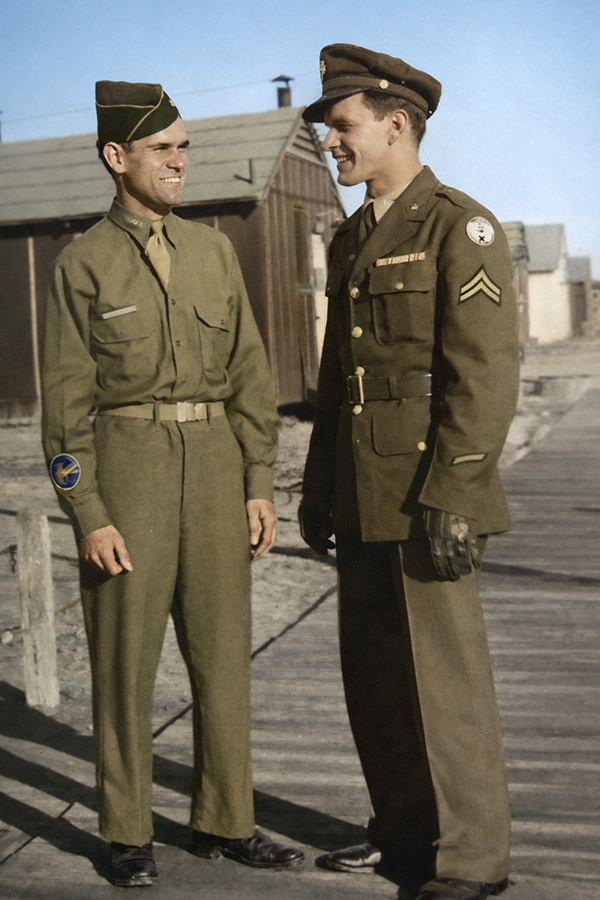
PETER A. PASTRAS PHOTOS (via Pastras Family)

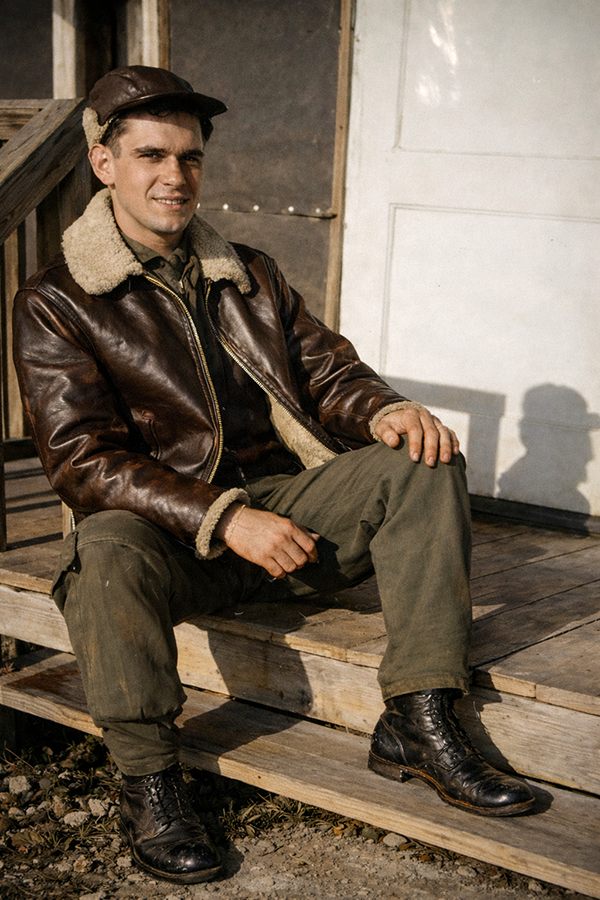
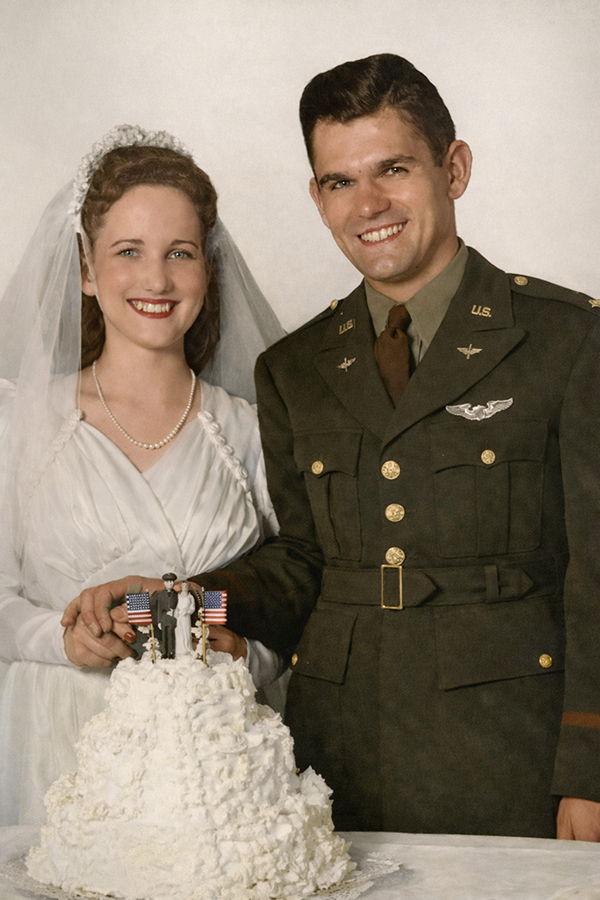
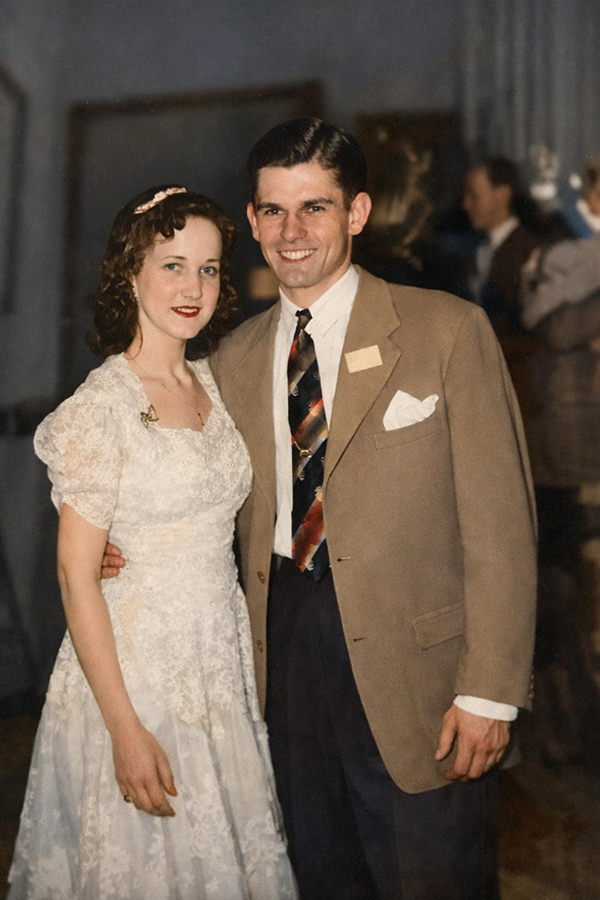

A NOTE FROM PASTRAS NIECES

In memory of our uncle Peter,
whose life we knew only through stories and the quiet pride of our family. Raised by his loving grandmother Elizabeth and his devoted aunts Merea & Molly, he shared his childhood with his brother Jack and sister Margaret. Though we never had the chance to meet him, our father’s emotion when speaking of Peter always reminded us of the depth of his courage and the sacrifice he made. We carry a silent pride in his service, and we honor the life he gave with gratitude and respect.
Lynn & Dawn Pastras
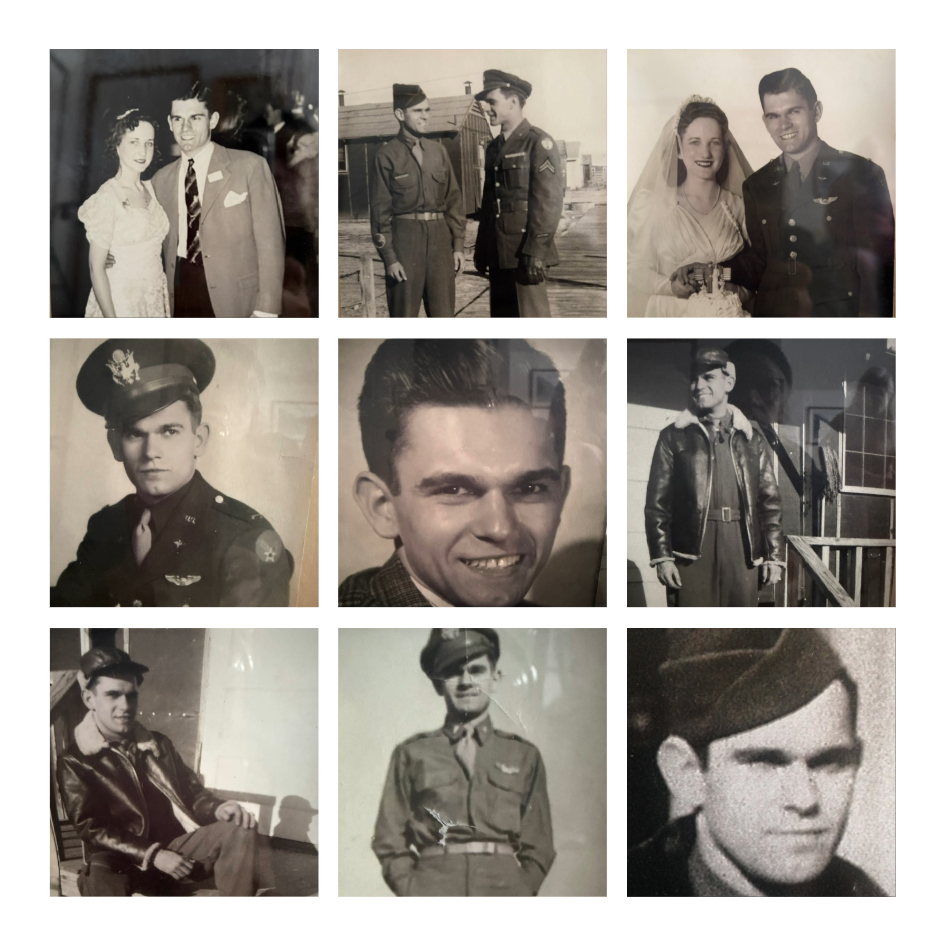
Improoving Photos through AI
The Image Restoration and Verification Agent was developed by the Greeks in Foreign Cockpits research team to support historically accurate and ethically controlled restoration of archival military photographs. For Peter Archie Pastras, restoration was required primarily to remove glare, reflections, and visual distortion caused by framed originals photographed behind glass. These conditions introduced optical artifacts that obscured facial detail, uniform features, and tonal depth, limiting reliable visual analysis in their uncorrected state. Corrections were limited strictly to stabilization—contrast recovery, tonal balance, and removal of surface reflections—without reconstructing missing information or introducing speculative elements. Facial structure, insignia, and period-correct textures were preserved within the bounds of what could be directly supported by the source material. Verification was conducted by cross-comparing restored images against multiple authenticated references of Pastras, including a single original photograph provided by Gary Hall and additional family-held images. Comparisons focused on immutable anatomical features—such as skull geometry, eye spacing, and jawline structure—rather than expression, lighting, or photographic style. Only restorations that returned consistently high similarity confidence across independent analytical systems were accepted. This process allows photographs affected by decades of handling, framing, and display to be used with confidence in scholarly and museum contexts. The restored images do not replace the originals, but function as analytically validated reference surrogates. In this way, restoration becomes an extension of historical documentation, preserving both visual fidelity and evidentiary integrity.
PETER ARCHIE PASTRAS COMBAT MISSIONS
| MISSION NUMBER | MISSION DATE | BOMBER SERIAL & NOSEART | DURATION | TARGET |
|---|---|---|---|---|
| 1 | 24-12-1944 | B-17G 43-37552, 'LL-E', The Peacemaker | 3:20 | "D" Merzausen "C" Kirch-Gons |
| 2 | 29-12-1944 | B-17G 42-37911, 'LL-C', Jeannie Marie / The Heats On | 3:20 | Bitburg |
| 3 | 03-01-1945 | B-17G 43-37988, 'DF-C', The B.T.O. | 2:30 | Cologne |
| 4 | 06-01-1945 | B-17G 43-38036, 'LL-H', Hey Daddy | 3:20 | Cologne |
| 5 | 10-01-1945 | B-17G 43-38036, 'LL-H', Hey Daddy | 3:15 | Ostheim |
| 7 | 15-01-1945 | B-17G 43-38036, 'LL-H', Hey Daddy | 4:10 | Ingolstadt |
| 8 | 17-01-1945 | B-17G 43-37887, 'LL-J', Old Battle Axe | 6:55 | Paderborn |
| 9 | 21-01-1945 | B-17G 42-32085, 'DF-H', Yankee Belle | 3:35 | Aschaffenburg |
| 10 | 28-01-1945 | B-17G | 6:20 | Cologne |
| 11 | 03-02-1945 | B-17G 43-38036, 'LL-H', Hey Daddy | 4:05 | Berlin |
| 12 | 06-02-1945 | B-17G 43-38036, 'LL-H', Hey Daddy | 4:00 | Gotha |
| 13 | 14-02-1945 | B-17G 43-38036, 'LL-H', Hey Daddy | 5:10 | Kassel |
| 14 | 16-02-1945 | B-17G 43-39014, 'LL-C', Hot Shot Charlie | 4:15 | Gelsenkirchen |
| 15 | 21-02-1945 | B-17G 44-6931 'LL-K', Ragged But Right | 4:15 | Nurnberg |
| 16 | 22-02-1945 | B-17G 43-38036, 'LL-H', Hey Daddy | 3:45 | Stendal |
| 17 | 24-02-1945 | B-17G 42-102504, 'LL-D', Times A-Wastin' | 3:45 | Hamburg |
| 18 | 01-03-1945 | B-17G 43-38036, 'LL-H', Hey Daddy | 4:25 | Heilbronn |
| 19 | 07-03-1945 | B-17G 43-39014, 'LL-C', Hot Shot Charlie | 3:45 | Dortmund and Giessen |
| 20 | 08-03-1945 | B-17G 43-38035, 'LL-F', Anxious Angel | 3:10 | Huls |
| 21 | 09-03-1945 | B-17G 43-37540, 'OR-Z', Ramblin' Rebel (maybe) | 3:30 | Kassel |
| 22 | 14-03-1945 | B-17G 42-97061, 'LL-B', General Ike | 3:55 | Orainieburg (Mechanical Abort) |
| 23 | 18-03-1945 | B-17G 43-39217, 'LL-O', Peg O My Heart / Merry Ann | 4:15 | Berlin |
| 24 | 19-03-1945 | B-17G 44-8324, 'LL-R' Blood n' Guts / Gypsie | 4:20 | Plauen, Germany |
| 25 | 21-03-1945 | B-17G 44-8324, 'LL-R' Blood n' Guts / Gypsie | 3:05 | Rheine / Salzbergen |
| 26 | 28-03-1945 | B-17G 43-38843, 'LL-L', unnamed | 4:05 | Spandau and Stendal |
| 27 | 31-03-1945 | B-17G 43-39014, 'LL-C', Hot Shot Charlie | 4:20 | Halle and Aschersleben |
| 28 | 04-04-1945 | B-17G 43-39217, 'LL-O', Peg O My Heart / Merry Ann | 4:10 | Fassberg |
| 29 | 05-04-1945 | B-17G 43-38843, 'LL-L', unnamed | 4:40 | Grafenwohl |
| 30 | 08-04-1945 | B-17G 42-102504, 'LL-D', Times A-Wastin' | - | Stendal |
SOURCES
1. Wisconsin Department of Health, Bureau of Vital Statistics, Original Certificate of Birth, Peter Archie Pastras, Certificate No. 311492.
2. Lansing State Journal, local notices and service profiles, 1942–1944.
3. U.S. Army enlistment records; Lansing State Journal, 10 November 1942.
4. Individual Flight Record, Peter A. Pastras, Army Air Forces, 1943.
5. Individual Flight Record, Pastras, pilot rating entry, 15 April 1944.
6. Army Air Forces training and replacement unit records, Drew Field, Florida.
7. 91st Bomb Group station records, RAF Bassingbourn.
8. 401st Bomb Squadron aircraft assignment records; Individual Flight Records, Pastras.
9. 91st Bomb Group Mission Reports; Eighth Air Force Target Directives, January–April 1945.
10. Formation position logs and mission debriefings, 401st Bomb Squadron.
11. Eighth Air Force Electronic Countermeasures summaries; Carpet Jammer operational reports.
12. Individual Flight Records; 401st Bomb Squadron operational tempo summaries.
13. U.S. Army Air Forces awards listings; IDPF, Pastras.
14. Missing Air Crew Report No. 14295, crew manifest.
15. 91st Bomb Group Mission Report No. 329, 8 April 1945.
16. MACR 14295, eyewitness statements.
17. MACR 14295, crew status and POW reports.
18. Quartermaster General Memorandum, “Identification of Unknown X-399,” 23 November 1945.
19. Individual Deceased Personnel File (IDPF), Peter A. Pastras, War Department correspondence, 1945–1949.
20. Quartermaster General letter to next of kin, June 1949; American Battle Monuments Commission records.
Special thanks are extended to Dawn Pastras and Lynn Pastras, nieces of Peter A. Pastras, for their generosity and family support; to Gary Hall for his invaluable assistance, research contributions, and for connecting us directly with the Pastras family; and to Jim Szpajcher for his continued guidance and expertise on Eighth Air Force personnel and records. Lastly we want to thank our researcher on National Archves, Donald Mounts from Global Military Research LLC for getting us the everything available from NARA as well as our follower Mindy Swift for deciphering handwritten letters especially those written in calligraphy.
